
English
Views: 0 Author: Site Editor Publish Time: 2026-11-06 Origin: Site


Cold storage facilities constantly battle a hidden enemy during daily operations. Every time a loading dock door opens, warm, humid air rushes into the chilled environment. This continuous thermal exchange creates significant challenges for facility managers and engineers striving to maintain strict climate control.
Inaccurate estimations of this moisture ingress lead to severe operational issues. You might face increased refrigeration energy consumption, dangerous ice buildup on evaporators, and severe safety risks like floor icing. Overworking cooling systems simply degrades equipment life and hurts overall facility efficiency.
This article provides a transparent framework to help you calculate the core latent loads entering your facility. We will guide you through practical methods to estimate moisture transfer and accurately size necessary environmental controls. You will learn actionable strategies to reduce ice formation, optimize equipment, and maintain a safer operational floor.
Air moves dynamically between environments seeking equilibrium. When workers open a loading dock door, a massive air change occurs. Warm air flows in through the upper portion of the doorway. Simultaneously, dense, cold air spills out across the floor. We classify this as an active air change. Conversely, infiltration represents the slow, continuous leakage occurring through compromised dock seals, wall cracks, and poorly fitted levelers.
Cooling moist air requires exponentially more energy than cooling dry air. Standard refrigeration removes sensible heat to lower the dry-bulb temperature. However, ambient air carries water vapor. When this humid air enters a sub-freezing room, the vapor condenses and freezes. This phase change releases tremendous latent heat. Your refrigeration system must work overtime to remove this excess heat load. Ultimately, ignoring latent loads leads to frozen evaporator coils, reduced cooling capacity, and costly defrost cycles.
Several distinct variables determine exactly how much moisture penetrates your cold storage zones. Recognizing these factors helps you model your environmental risks accurately.
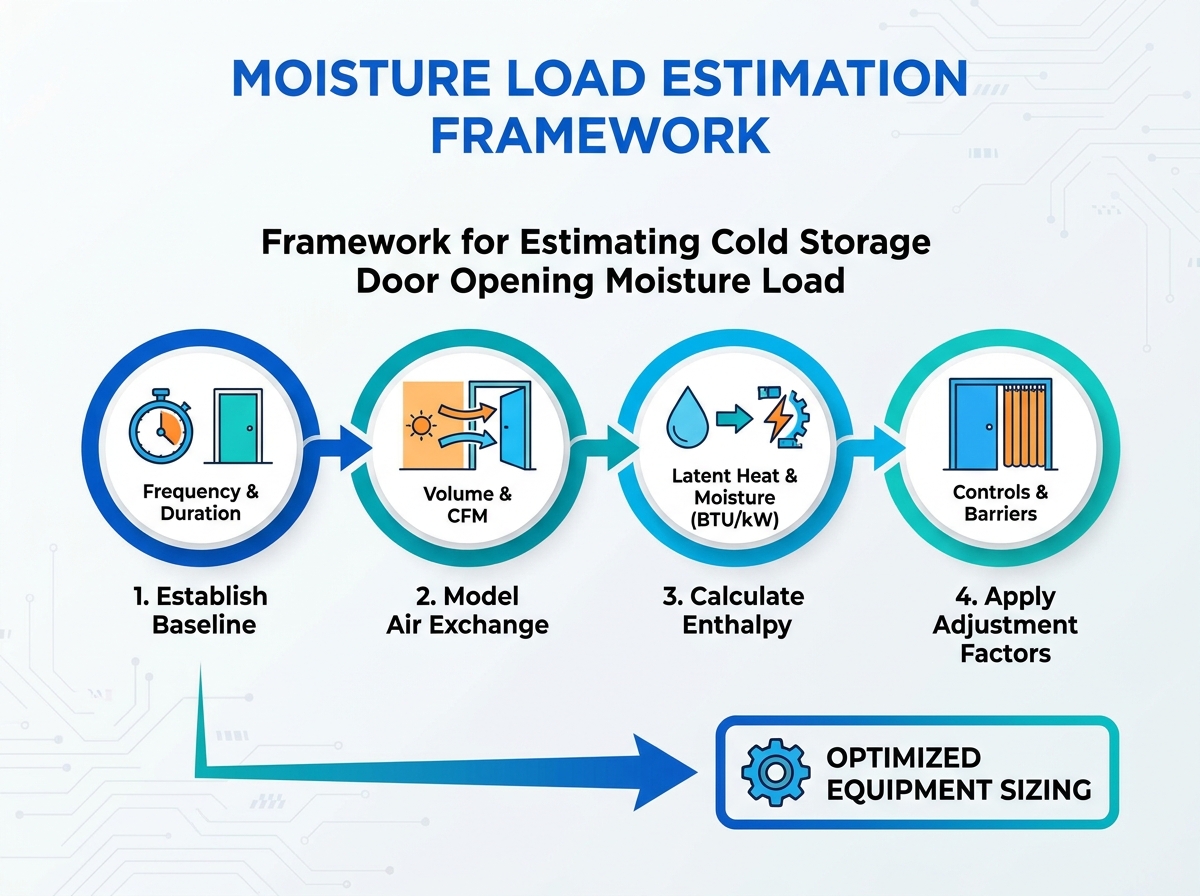
To effectively calculate the cold storage door opening moisture load, engineers must follow a transparent, structured approach. Guesswork routinely leads to undersized equipment and operational failure.
You cannot mitigate what you do not measure. Begin by tracking facility usage metrics. Record the exact number of door cycles per shift. Measure the average duration each door remains open during a loading event. Document the physical dimensions of every doorway. These baseline metrics serve as the foundation for your volumetric air transfer calculations.
Industry standards, such as those published by ASHRAE, provide reliable methods to estimate air transfer volumes. The density-driven flow equation evaluates the height of the door, the temperature difference between the two spaces, and the time the door stays open. This model calculates the total cubic feet per minute (CFM) of unconditioned air entering the cold space per opening event.
Once you know the volume of air transferred, you must determine its energy content. Consult a psychrometric chart to find the enthalpy of the ambient dock air and the enthalpy of the cold room air. The difference between these two values represents the total heat gain. You then convert this difference into BTUs per hour or kilowatts. This metric tells you exactly how much cooling capacity you lose to moisture ingress.
Calculations based on an open hole in a wall rarely reflect reality. Facilities utilize environmental controls to restrict airflow. You must apply adjustment factors to your raw calculations based on the mitigation hardware currently in place.
| Doorway Protection Type | Estimated Effectiveness (Airflow Reduction) | Operational Notes |
|---|---|---|
| Unprotected Open Door | 0% | Maximum moisture and thermal transfer. |
| Standard Strip Curtains | 70% - 80% | Effectiveness degrades quickly as strips break or warp. |
| High-Speed Roll-Up Doors | 85% - 90% | Highly effective when paired with strict usage policies. |
| Vestibule / Airlock System | 90% - 95% | Creates a physical buffer zone for optimal isolation. |
Many facility operators expect their refrigeration systems to manage ambient humidity. This assumption consistently causes trouble. Evaporator coils handle sensible cooling effectively. They lower the air temperature. They do not selectively remove moisture. When moist air hits a sub-freezing coil, vapor freezes instantly. This frost acts as an insulator. It blocks airflow and forces the unit into energy-heavy defrost cycles. True dehumidification requires removing moisture before it ever touches a freezing surface.
Location matters immensely when deploying moisture control equipment. Treating the main freezer room treats the symptom, not the source. The best practice involves treating the airlock or the loading dock itself. By maintaining a dry vestibule, any air entering the freezer is already stripped of its moisture. This strategic placement starves the cold room of humidity, virtually eliminating ice formation on floors and coils.
Proper loading dock dehumidification sizing prevents excessive capital expenditure while ensuring adequate moisture removal. Engineers match dehumidifier capacity directly to the peak CFM of air exchange calculated during the modeling phase. You must evaluate the maximum moisture load entering during the busiest shift on the most humid day of the year. Sizing for averages leaves facilities vulnerable during peak summer conditions.
Dehumidifiers and refrigeration units must work harmoniously. Poor integration creates system conflicts. For example, running a dehumidification purge during an evaporator defrost cycle wastes energy. Modern installations link dehumidification units to central programmable logic controllers (PLCs). This connectivity allows systems to share dew point data and stagger operational cycles efficiently.
Choosing the right physical barrier impacts your overall thermal leakage. Strip curtains offer a low initial purchase price. However, they suffer from high wear and tear. Forklifts easily rip them, and cold temperatures make them brittle. Thermal leakage increases drastically as they degrade. High-speed roll-up doors open and close in seconds. They minimize the time the threshold remains unsealed. While they require a larger upfront investment, they deliver superior ROI through massive energy savings and reduced ice accumulation.
The interface between the building and the transport truck is notoriously difficult to seal. Traditional pit-style dock levelers create continuous gaps at the bottom corners of the door. These gaps allow constant infiltration. Vertical storing dock levelers solve this problem. They store upright inside the building, allowing the overhead door to close tightly against the concrete floor. This configuration maintains a complete thermal envelope and severely restricts latent load infiltration.
Equipment selection requires a long-term perspective. Evaluate mitigation technologies over a 10-year horizon. Focus closely on three main variables:
Moisture control directly affects regulatory compliance. The Food Safety Modernization Act (FSMA) mandates strict temperature controls to prevent bacterial growth. Condensation forming on ceilings and dripping onto packaged food creates serious contamination risks. Furthermore, frozen condensation on concrete floors violates OSHA safety standards by creating extreme slip hazards for workers and forklifts. Effective latent load management keeps your facility compliant and safe.
Technology alone cannot solve moisture ingress. Operational behavior plays a massive role. Forklift drivers frequently bypass automatic door timers to speed up loading operations. They wedge doors open, completely negating environmental controls. Facility managers must conduct rigorous staff training. Teams need to understand how leaving a door open directly causes the slippery floors and foggy conditions they complain about. Combining technology with strict behavioral enforcement yields the best results.
You need data to prove your mitigation strategies actually work. Install dew point sensors throughout the loading dock and inside the cold room. Track the humidity trends before and after installing high-speed doors or dehumidifiers. A successful implementation will show a flattened dew point curve, even during high-traffic loading shifts. Continuous monitoring alerts you instantly if a door seal fails or a dehumidifier requires maintenance.
The most common engineering mistake is treating moisture problems by simply adding more cooling capacity. Upsizing an evaporator coil treats the symptom but ignores the source of the moisture. This brute-force approach guarantees higher utility bills and endless defrost cycles. Data-first engineering beats equipment-heavy solutions every time. Calculate the load accurately, stop the moisture at the door, and let your existing refrigeration run efficiently.
Precise calculation of moisture load forms the essential foundation of any efficient cold storage strategy. Guessing the volume of humid air entering your facility leads to dangerous ice buildup and stressed refrigeration equipment. The physics of latent heat demand a proactive approach to moisture control.
Your best path forward starts with a comprehensive audit. Track your current door usage, measure the environmental variables, and calculate the actual latent gain. Once you establish the baseline, you can right-size the environmental control equipment necessary to protect your thermal envelope.
Before committing to major capital expenditures, always validate your calculations. Consult experienced thermal dynamics specialists. They can verify your models and ensure your dehumidification and barrier technologies will perform exactly as required under peak load conditions.
A: Door frequency acts as a massive latent load multiplier. Every opening cycle introduces ambient moisture. The more frequently doors open, the more water vapor enters the space. Refrigeration systems must be sized to handle this phase-change energy, otherwise, they will fail to maintain target temperatures during busy shifts.
A: You generally need both, but prioritize physical barriers first. High-speed doors minimize the total volume of air entering the facility. Once you reduce the airflow mechanically, you can invest in a smaller, more efficient dehumidification system to handle the remaining moisture. This balance optimizes operational costs.
A: You need accurate temperature and humidity logs for both the indoor and outdoor environments. You also must record exact door dimensions, the average duration doors remain open, and the total number of opening cycles per shift. This data drives the volumetric transfer equations.
A: No. Strip curtains provide basic airflow restriction, but they cannot stop moisture diffusion entirely. They frequently break, gap, or warp in cold environments, reducing their effectiveness to near zero. They are a helpful secondary measure, but they cannot replace proper dehumidification in high-humidity regions.


