
English
Views: 0 Author: Site Editor Publish Time: 2026-11-01 Origin: Site


Lithium-ion battery manufacturing operates in a high-stakes reality. Facilities must maintain ultra-low dew points, often ranging from -40°C to -60°C or even lower. Because of these extreme conditions, dehumidification systems can account for up to 40% of a gigafactory’s entire energy consumption. Finding the right balance is incredibly difficult. Undersizing your system severely compromises delicate cell chemistry and drastically reduces production yields. Conversely, oversizing leads to millions wasted on unnecessary capital expenditure and inflated operating expenses. To solve this, you need a precise moisture load budget. This document acts as the foundational engineering baseline for any new facility. In this article, we will show you how to structure this calculation accurately. You will learn how to account for every moisture source and evaluate dehumidification vendor proposals objectively.
We must define success criteria early in the facility design phase. Your moisture load budget directly dictates the size of your desiccant dehumidification system. It also determines the scale of your ductwork and supporting cooling infrastructure. If you get this baseline wrong, the financial and operational consequences are severe.
Consider the daily cost of inaccuracy. Undersizing poses a catastrophic risk to your battery product. Lithium reacts aggressively when exposed to airborne moisture. This chemical reaction forms hydrofluoric acid. The acid destroys electrodes and forces immediate production halts. You lose raw materials, production time, and revenue. On the other hand, oversizing creates a massive financial burden. You spend unnecessary capital on oversized desiccant rotors. You also waste ongoing thermal energy to reactivate those massive rotors continuously. Large systems require massive heater banks and larger chiller plants, driving up your utility bills permanently.
A standardized load calculation provides a clear vendor evaluation lens. Procurement teams use it to compare bids from competing dehumidification vendors fairly. When you provide a strict moisture load budget, you can strip away inflated, vendor-specific safety margins. This ensures a true "apples-to-apples" comparison. You evaluate vendors based on engineering facts rather than optimistic sales promises. You take control of the design narrative.
Structuring your battery dry room moisture load calculation requires methodical attention to detail. You must break the room down into specific moisture sources and analyze them individually.
You must establish clear starting assumptions before calculating specific loads. Define your target dry room temperature and your target dew point. Identify the surrounding ambient conditions accurately. You should use recognized facility location design days. Industry standard bodies, like ASHRAE, recommend using 0.4% or 1% extreme annual design conditions. This practice ensures your dehumidification system handles peak summer humidity without failing.
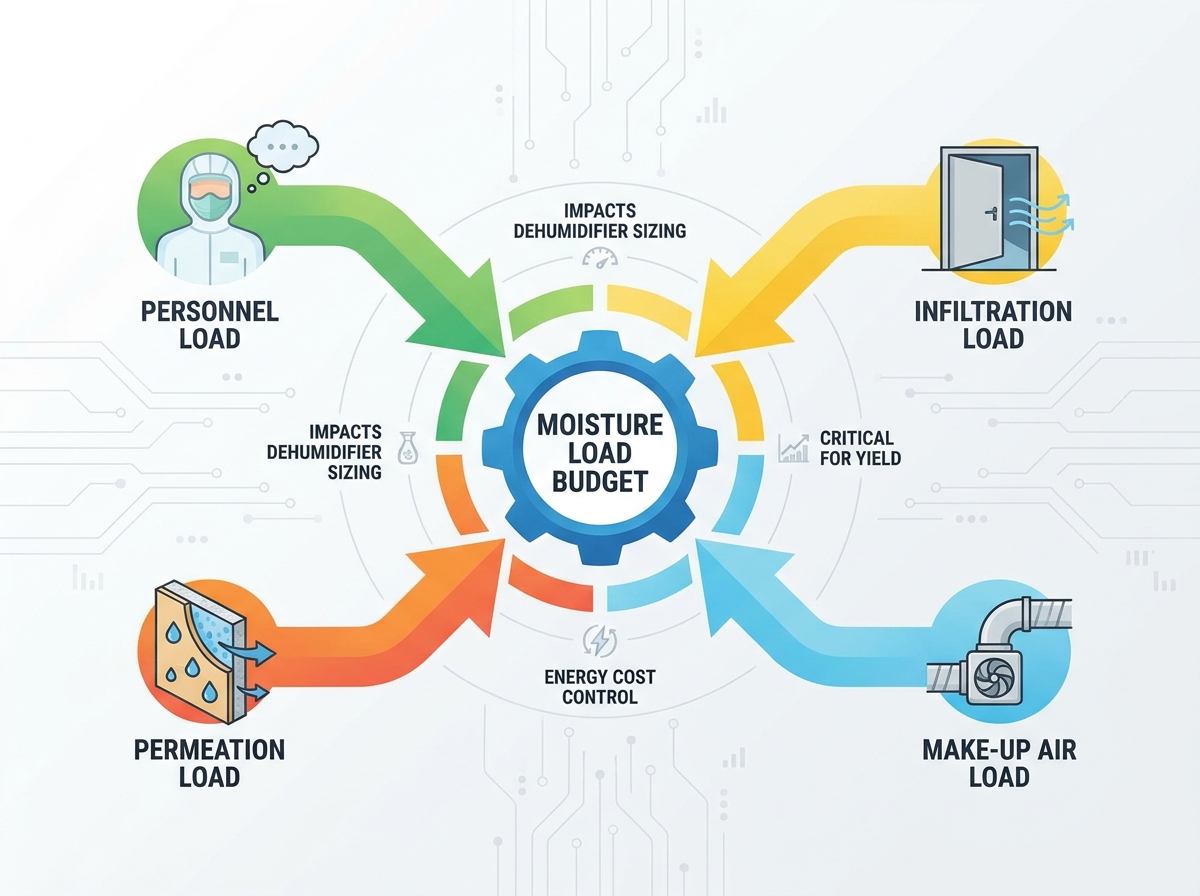
Human operators constantly emit moisture through respiration and perspiration. You must calculate this latent heat based on specific activity levels inside the room. An operator sitting at a testing station emits significantly less moisture than one walking and carrying heavy materials. Specialized cleanroom suits complicate this dynamic. These suits retain moisture initially but eventually reach an equilibrium point. Once saturated, they release moisture steadily into the room. You must account for this steady-state emission rather than assuming the suits trap all moisture indefinitely.
Moisture constantly tries to enter your controlled space. You must identify moisture entering through door openings, material airlocks, and conveyor pass-throughs. A massive vapor pressure differential drives this entire process. Ambient summer air has a very high vapor pressure. The negative-dew-point space inside the dry room has a near-zero vapor pressure. This extreme differential forces moisture through any tiny opening. Calculating your dry room infiltration load accurately prevents sudden, uncontrollable humidity spikes.
Moisture migrates directly through solid architectural materials. It moves constantly through wall panels, ceiling joints, and floor slabs. You must calculate this permeation load using material-specific permeance ratings. High-grade vapor barriers are absolutely necessary for battery facilities. Poor architectural sealing introduces a constant, hidden moisture load. You must specify building envelope materials with extremely low vapor permeance to minimize this invisible threat.
Battery manufacturing processes generate toxic exhausts. You must vent solvent fumes safely to protect workers. You then need fresh make-up air to replace the exhausted air. This replacement air maintains positive room pressurization. This fresh air comes from outside, carrying a massive moisture load. You must dehumidify this air from ambient conditions down to your sub-zero dew point. Make-up air often represents the largest single load component in your entire calculation.
Table: Typical Moisture Load Distribution in Battery Dry Rooms| Load Component | Typical Share of Total Load | Primary Control Strategy |
|---|---|---|
| Make-up Air | 50% - 70% | Pre-cooling coils and primary desiccant wheels |
| Personnel | 10% - 20% | Automation and specialized cleanroom garments |
| Infiltration | 10% - 15% | Active airlocks and high-speed roll-up doors |
| Permeation | 1% - 5% | Welded panel joints and epoxy floor coatings |
Theoretical calculations often fail when applied to the real world. You must anticipate harsh operational realities during the design phase.
Operator behavior rarely matches pristine engineering models. Engineers usually assume doors remain open for a theoretical minimum time. Real-world material handling tells a very different story. Operators frequently prop doors open for convenience. Heavy material carts get stuck in airlocks. These common events cause extended infiltration spikes. You must build realistic, imperfect usage profiles into your models to prevent system crashing.
Beware the dangerous trap of compounding safety factors. A facility engineer might add a 10% safety margin to the initial calculation. The EPC contractor adds another 10% to protect their liability. Finally, the equipment vendor adds their own 10% safety buffer. These margins compound mathematically. You end up with a massively oversized system. It runs inefficiently at part-load conditions, over-drying the air and wasting reactivation heat constantly.
You must also factor in aging infrastructure. Physical performance degrades over time. Heavy-use door seals wear out quickly. Wall panel joints settle and crack under structural vibration. Silicone caulking shrinks and loses elasticity. Your initial load calculation must account for this inevitable degradation. A dehumidification system sized perfectly for day one might fail completely in year three if you ignore facility aging.
Your calculated moisture load directly informs your final equipment choice. You must evaluate different solution categories carefully. Manufacturers typically choose between single-rotor, dual-rotor, or hybrid desiccant dehumidification configurations based on the load profile.
You must map specific equipment features to your desired outcomes:
Accurate load data justifies critical energy recovery investments. Desiccant reactivation requires intense, continuous heat. You can incorporate air-to-air heat recovery systems to capture waste exhaust heat. You then use this recovered thermal energy to pre-heat incoming reactivation air. This strategy slashes your monthly utility bills. Precise load data proves the ROI of these recovery systems definitively.
You have compiled your budget. Now you must validate it and act on the data.
We highly recommend strict third-party auditing. Have your moisture load calculation peer-reviewed before issuing any RFP. Hire an independent psychrometrics or industrial HVAC specialist. They will spot missing variables and challenge your underlying assumptions. This independent review prevents costly sizing mistakes early in the design phase.
Use your completed load budget for intelligent shortlisting logic. Challenge your prospective vendors directly. Ask them to prove how their specific equipment handles your calculated peak loads. More importantly, ask how their units perform under part-load conditions. Systems must operate efficiently during dry winter months or low-production night shifts without wasting energy.
Your actionable takeaway is simple. Move from theoretical calculation to rigid specification. Finalize your RFP documents carefully. Attach your completed moisture budget as a binding baseline for all bidders. Force vendors to provide strict performance guarantees against your specific numbers. This strategy shifts the performance risk away from you and onto the equipment vendor.
A moisture load budget represents a critical risk-mitigation tool for any battery manufacturer. It is much more than a simple mathematical exercise. To ensure success, follow these actionable steps:
Accurate calculations empower manufacturers to take control of their facilities. You can build resilient, highly energy-efficient battery dry rooms. These controlled rooms will scale effectively with your production goals without ever compromising delicate cell integrity.
A: Make-up air and personnel are typically the largest contributors. Fresh air brought in to replace toxic solvent exhaust carries massive humidity from outside. However, poorly designed conveyor openings or propped-open doors can cause massive, unpredictable infiltration spikes.
A: Uncontrolled infiltration introduces highly humid ambient air into the dry space. This forces the desiccant wheel to process a much higher moisture grain depression. To handle this spike, you need larger desiccant wheels, higher airflow rates, and significantly more thermal reactivation energy.
A: Standard HVAC load calculations focus primarily on sensible cooling and basic human comfort. Battery dry rooms require extreme latent load calculations. These are based on massive vapor pressure differentials at sub-zero dew points, which standard HVAC software cannot model accurately.
A: You should recalculate your moisture budget whenever production capacity scales up. You must also recalculate if staffing levels change, if you add new process exhaust requirements, or if physical modifications are made to the room’s architectural envelope.


