Defining a precise drying endpoint for confectionery production remains one of the most significant challenges for manufacturers aiming for product consistency. When moisture levels remain too high, you risk microbial growth, shortened shelf life, and unsightly sugar bloom that ruins visual appeal. Conversely, aggressive over-processing leads to texture degradation, flavor profile shifts, and significant energy waste. Achieving the right balance requires more than just subjective observation; it demands a rigorous, data-driven approach to environmental and product monitoring. By standardizing your process, you move beyond guesswork and ensure every batch meets quality expectations. In this guide, we explore the methodology behind establishing a reliable
candy tray drying endpoint. You will learn how to leverage sensors, weight metrics, and standardized documentation to create a scalable, repeatable protocol that optimizes your production workflow while maintaining the highest food safety standards.
Key Takeaways
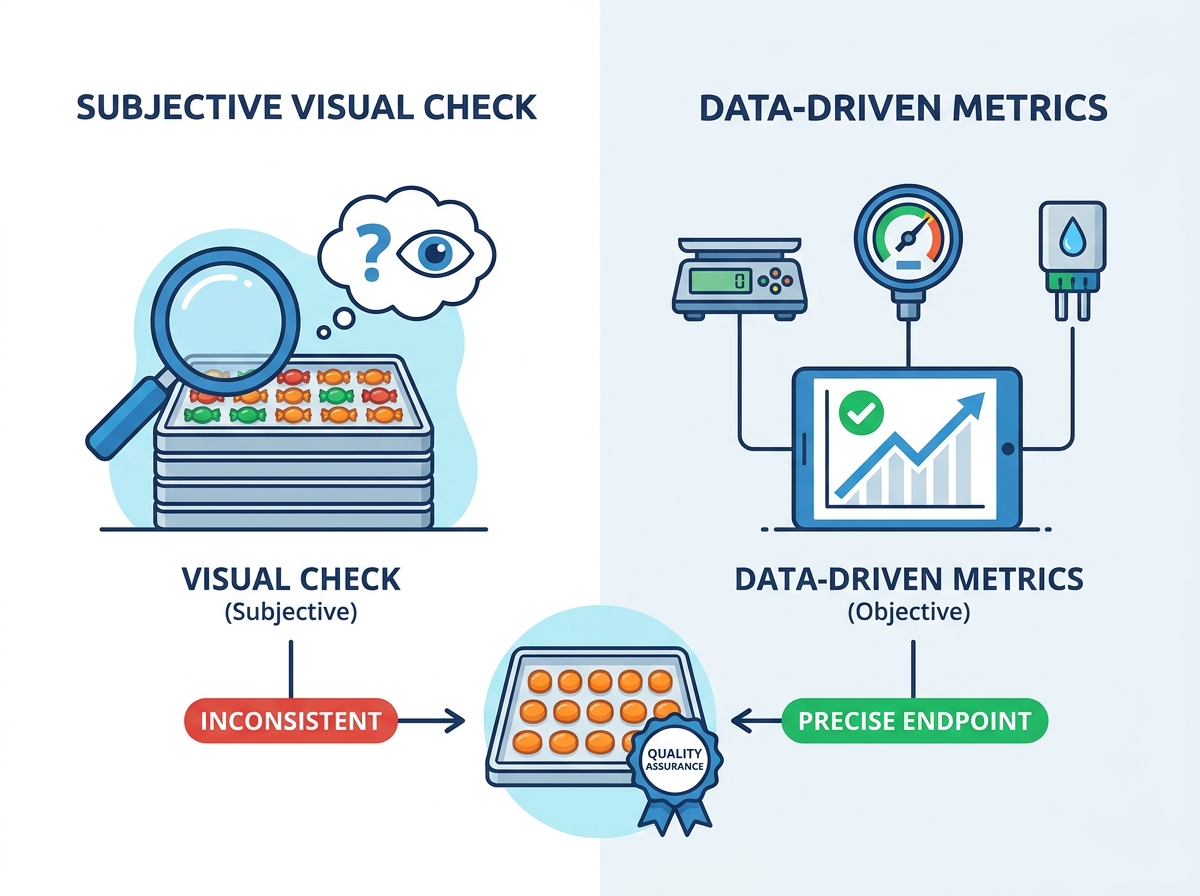
- The "dry" look is subjective; reliance on objective metrics (weight loss, chamber pressure, temperature probes) is mandatory for consistency.
- Understanding the specific latent heat and moisture content of your candy formulation is the first step in setting a baseline.
- Implementing a consistent tray loading pattern is as important as the cycle parameters themselves.
- Validation of the endpoint requires a controlled, iterative process rather than one-off adjustments.
Defining Your Baseline: The Mechanics of Moisture Removal
Understanding the physics of moisture removal is essential for any production team. Sugar-based products contain both free water, which evaporates easily, and bound water, which requires specific thermal energy to release. You must account for these different states when designing your drying cycle. If you fail to distinguish between them, your drying times will fluctuate wildly between batches. The ultimate success criterion should never be visual appearance. A product may appear dry on the surface while still holding high internal moisture content. Instead, focus on Water Activity (Aw), the industry standard for measuring free water available for microbial growth. By targeting a specific Aw level, you ensure shelf-life stability regardless of the ambient environment. Tray configuration also dictates success. When trays are overcrowded or unevenly distributed, airflow becomes restricted. This causes uneven drying across the stack, forcing you to extend cycle times to compensate for the slowest-drying tray. To achieve professional
confectionery tray drying validation, standardize your loading pattern so airflow remains uniform throughout the entire chamber.
Essential Tools for Precision Monitoring
To move away from intuition, you need specific instrumentation. Calibrated scales are your first line of defense. By measuring the total weight of the loaded trays before and after the cycle, you calculate the mass of evaporated water. Tracking this over time reveals the precise moment the rate of moisture loss plateaus, signaling the end of the cycle. Chamber sensors provide secondary confirmation. Modern drying systems monitor pressure and temperature simultaneously. As the candy dries, the moisture load in the air decreases, causing a shift in sensor readings. A stabilization in chamber pressure indicates that evaporation has ceased, providing a reliable trigger for automatic cycle termination.
The following table outlines the primary metrics used to determine the end of a drying cycle.
| Metric | Monitoring Tool | Role in Process |
| Product Mass | Industrial Scale | Quantifies total moisture removed from the batch. |
| Water Activity | Aw Meter | Ensures microbial stability and shelf-life compliance. |
| Vapor Pressure | Chamber Sensor | Detects the plateau where evaporation stops. |
| Relative Humidity | Digital Hygrometer | Confirms the environment is dry enough for equilibrium. |
Establishing a Standardized Drying Validation Protocol
Validation turns a good idea into a repeatable system. Start by creating a control batch. Carefully record every environmental parameter, including humidity, air speed, and temperature. Weigh the trays before loading, during intermediate checks, and after the process concludes to map the moisture reduction curve. Documentation serves as your master record. Every production run should link the cycle parameters to the final moisture results. If a batch fails quality inspection, this log allows you to backtrack and identify which variable deviated from the norm. It is essential for maintaining consistent, high-quality output. Scalability requires adjustments. When you move from R&D trials to full-capacity production, the increased product mass will change the drying dynamics. Always recalibrate your expectations when loading more trays. A system that works for one tray may require a longer cycle time when the chamber operates at full capacity.
Common Operational Risks and Mitigation Strategies
Uneven drying often stems from poor airflow patterns or improper tray spacing. If you notice localized soft spots in your product, examine the internal geometry of your dryer. Ensure that air circulates freely between all trays. If necessary, use spacers to maximize surface area exposure. "False dry" signals can sabotage your productivity. Cold spots inside the chamber or sensor lag can make it appear as though the moisture has been removed when it hasn't. Always verify readings using an external, calibrated hygrometer. This simple step prevents the premature termination of cycles. Material compatibility also matters. Reusable trays must withstand your operating temperatures without releasing chemicals or outgassing. If you use plastic trays, ensure they are food-grade and heat-stable. Substandard materials can introduce contaminants during the final stages of the cycle, potentially compromising your product quality.
Integrating Data into Your Workflow
Data should drive your operator decisions. Instead of letting staff guess when a cycle is finished, provide them with a clear decision framework. If the sensors report a specific pressure value and the elapsed time meets the minimum requirements, they can reliably stop the machine. This removes ambiguity from the production floor. Continuous improvement keeps your process relevant. Seasonal changes significantly affect ambient humidity levels. You must refine your endpoint parameters periodically to compensate for these environmental shifts. A static setup will eventually drift, leading to inconsistent quality as the seasons change. Compliance and Quality Assurance demand transparency. Maintain a clear, accessible log of every drying cycle. Regulatory bodies and internal audits require this data to confirm your commitment to food safety. A robust record system not only keeps you compliant but also protects your brand reputation by ensuring only perfect products reach the consumer.
Conclusion
Defining a candy tray drying endpoint is an exercise in data-driven process control. By moving from anecdotal observations to quantifiable metrics, you gain total control over your production environment. This transition reduces waste, improves energy efficiency, and ensures that your confectionery items consistently meet quality standards. Start by implementing an iterative, documented validation process that accounts for your unique formulations and equipment constraints. As you refine these protocols, you will build a foundation for operational excellence that withstands the challenges of scaling and market variations. Adopting a rigorous methodology is not just a technical upgrade; it is a commitment to the quality and longevity of your product.
FAQ
Q: What is the most accurate way to verify my candy is fully dry?
A: The industry gold standard is Water Activity (Aw) testing. Unlike moisture content, which measures total water, Aw measures the energy status of water in the product. It provides a direct indicator of shelf life and microbial safety. Always verify your results with a calibrated Aw meter to ensure your product is stable for storage.
Q: How does tray loading density affect my drying endpoint?
A: Higher tray loading density increases the mass of water that must be removed. This restricts airflow and lengthens the time required to reach equilibrium. If you increase the quantity of product per tray, you must extend the cycle time or adjust the air temperature to ensure uniform drying across all levels.
Q: Can I rely solely on visual inspection to determine if a cycle is finished?
A: Visual inspection is unreliable for determining dryness. It only reveals surface-level texture. Internal moisture can remain trapped even if the exterior feels firm. Relying on appearance often leads to inconsistent quality and "hidden" moisture that causes spoilage later. Always use objective data like weight loss or sensors.
Q: What is the role of humidity in determining my drying endpoint?
A: Ambient humidity directly impacts the equilibrium moisture content of your candy. If the air in your drying chamber is too humid, the product cannot release its internal water, regardless of how long you run the cycle. You must monitor and control the dew point to ensure the drying air remains capable of absorbing moisture.
Q: How often should I re-validate my drying parameters?
A: You should re-validate parameters whenever you change your recipe, adjust batch sizes, or perform major equipment maintenance. Additionally, conduct seasonal reviews to ensure that variations in external climate do not affect your baseline performance. Regular validation ensures your process remains accurate and compliant over time.


