
English
Views: 0 Author: Site Editor Publish Time: 2026-11-08 Origin: Site


High-volume PET preform production demands aggressive mold cooling. This minimizes cycle times. It also ensures preforms remain amorphous and highly transparent. However, running chilled water through molds in ambient humidity causes immediate problems. Molds operating at 5°C to 10°C drop below the surrounding dew point rapidly. Condensation forms on the tooling instantly. This forces molders into a highly costly compromise. You can either raise the coolant temperature and sacrifice cycle time, or you can risk severe part defects and permanent tooling damage. Effectively managing this environmental variable is crucial for long-term profitability. You must transition from reactive, temporary solutions to engineered atmospheric control directly at the molding cell. In this article, you will learn the true operational costs of condensation. We will explore why traditional facility fixes consistently fail. Finally, we will detail proven, actionable strategies for maintaining ultra-low dew points around your tools year-round.
Moisture on the cavity and core inserts acts as a dangerous barrier during plastic injection. When molten PET hits this water, the liquid instantly vaporizes into steam. This trapped steam causes visible watermarks on the preform surface. It creates severe visual blemishes. Furthermore, temperature inconsistencies from water droplets cause localized crystallization. This manifests as milkiness or haziness in the PET preforms. Such defects ruin optical clarity completely. They render the preforms entirely unusable for downstream blow molding processes. You end up throwing away expensive resin.
The long-term impact on expensive mold metallurgy is equally devastating. Condensation initiates aggressive oxidation on the tool surface. Rust and pitting develop quickly on critical faces. This degrades the highly polished finish required for clear PET production. Moving components suffer immensely under wet conditions. Ejector pins, neck rings, and slide mechanisms experience accelerated wear. They rapidly lose their precise engineering tolerances. Moisture strips away essential lubrication from these moving parts. This ultimately leads to mechanical seizing and catastrophic tool failure.
We must also calculate the hidden costs of unplanned downtime. Operators frequently stop the machine to manually wipe wet molds. This severely impacts daily production schedules. Scrap rates always increase during humid summer shifts. These combined factors cause massive drops in your Overall Equipment Effectiveness (OEE). Your machine availability plummets due to frequent manual wiping. Your performance drops if you slow the cycle to compensate. Your quality rate falls due to haziness and watermarks. Every hour spent managing moisture directly destroys your operational profitability.
Many facilities attempt to manage moisture by simply increasing chilled water temperatures. This approach represents a massive false economy. Every 1°C increase in coolant temperature prevents condensation marginally. However, it extends the necessary cooling time inside the mold. Longer cooling times mean slower overall cycle times. This severely degrades your annual production volume. You protect the mold temporarily, but you sacrifice your primary competitive advantage. High-speed PET molding relies entirely on rapid cooling phases. Adjusting the chiller upwards destroys this efficiency.
Standard plant-wide air conditioning is another common misstep. Facility HVAC systems cool massive volumes of air across the factory floor. They are fundamentally incapable of cost-effectively reaching ultra-low dew points. They drop the air temperature but leave too much absolute moisture behind. Achieving a dew point suitable for 5°C mold operations requires specialized equipment. Standard air handlers simply cannot remove enough water vapor from the environment. They provide comfort cooling, not precision industrial dehumidification. Relying on them guarantees persistent condensation issues.
Some operators rely on chemical rust preventatives. They spray these compounds directly onto active tooling surfaces. This method has severe operational limitations. The chemicals instantly contaminate the PET preforms. The first several shots are always ruined. Furthermore, the aggressive molding environment quickly burns off the spray. Operators must constantly reapply the chemical during active production runs. This introduces continuous manual intervention. It adds unnecessary labor costs. It creates massive scrap every time the mold restarts. These reactive methods never solve the root atmospheric problem.
Implementing robust PET injection mold condensation control requires targeted strategies. You must address the micro-climate directly surrounding the tool. The foundation of this strategy is the mold enclosure. You must physically isolate the mold area from ambient plant air. We call these structures mini-environments. They prevent humid facility air from reaching the chilled steel. You should evaluate enclosure materials carefully. Polycarbonate panels offer excellent visibility and rigidity. Flexible PVC curtains provide easier access for maintenance. However, material choice is secondary to sealing integrity. You must ensure perfect seals around the tie bars. Robot entry points require precise cutouts or synchronized automated doors. Any gap allows moisture to rush in.
Inside this isolated enclosure, you need highly specialized air management. This is where desiccant dehumidification systems excel. They route continuous dry air for chilled molds directly into the enclosed space. These systems rely on continuous-duty desiccant rotors. The rotor absorbs moisture continuously from the air stream. It then rotates into a separate regeneration sector. Here, intense heat expels the trapped water outside the facility. This mechanical process ensures a highly stable, sub-zero dew point. It bathes the mold in bone-dry air regardless of the weather outside.
Compressed air blanketing is a supplemental approach. It uses instrument-quality compressed air to displace humid air. The plant compressor dries the air thoroughly before delivery. However, this approach serves very niche applications. The operational cost of generating clean compressed air is exceptionally high. Airflow limitations restrict its overall effectiveness. It cannot flush the volume required for large, multi-cavity PET tools quickly enough. You will waste massive amounts of expensive compressed air trying to keep a 96-cavity tool dry. It remains impractical for high-volume operations.
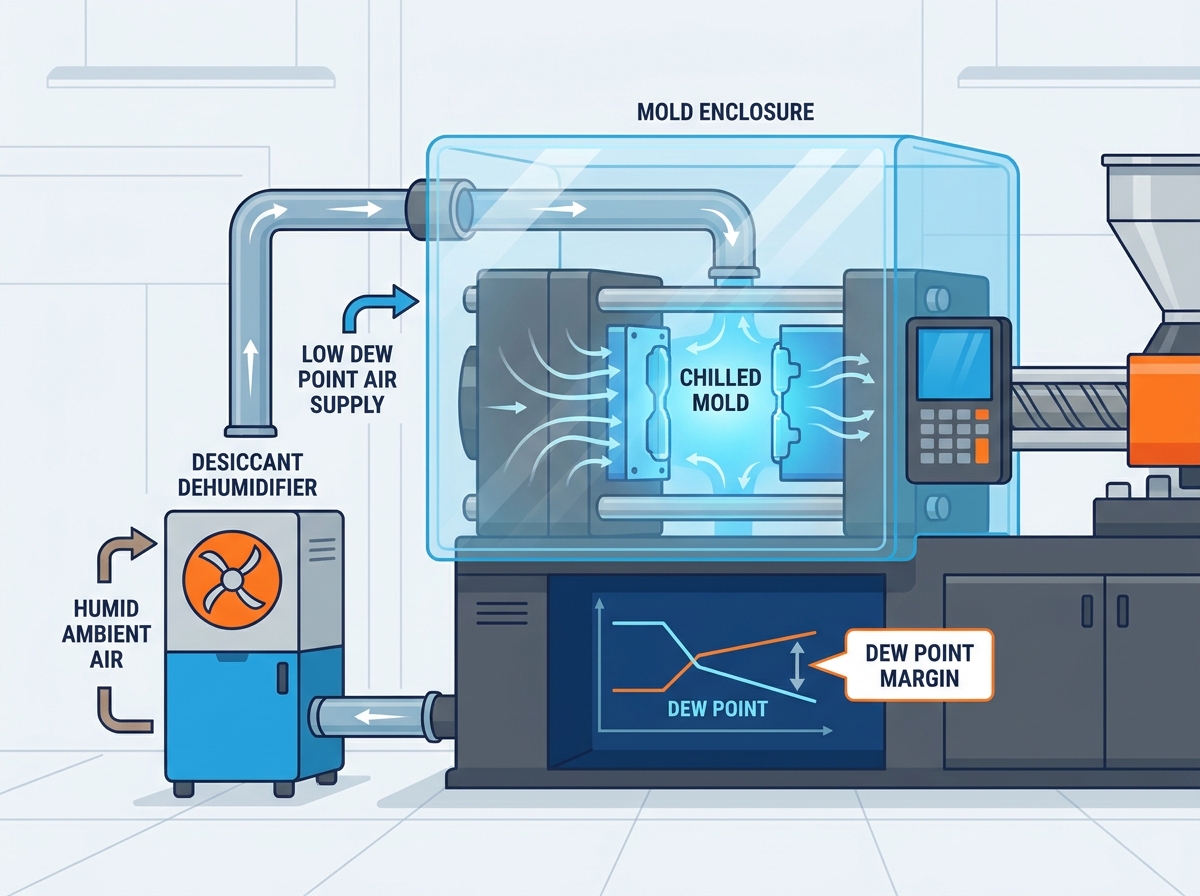
Selecting the right dehumidifier dictates the success of your molding operation. You must rigorously evaluate specific performance metrics. First, verify the unit's actual dew point delivery capability. The equipment must consistently deliver air with an ultra-low dew point. This ambient dew point must remain at least 2°C to 5°C lower than your coldest chilled water setpoint. It must sustain this strict performance regardless of seasonal ambient humidity spikes. Summer rainstorms should not impact your delicate mold environment. The system must adapt instantly.
Next, calculate your airflow and capacity sizing requirements. You measure this in Cubic Feet per Minute (CFM). Base your calculations on the total physical volume of the mold enclosure. You must also factor in the cycle time carefully. Consider the exact frequency and duration of mold open times. The system must completely flush humid air out of the enclosure every time the mold operates. If the CFM is too low, ambient moisture will infiltrate during the ejection phase.
Energy efficiency heavily impacts your operational overhead over time. Assess the power consumption of the desiccant regeneration process. Heating the desiccant wheel requires significant electrical energy. Look for modern systems utilizing waste heat recovery. Highly efficient variable frequency drives (VFDs) also optimize internal blower speeds. They reduce electricity usage significantly during steady-state operations. A smartly designed system minimizes its own energy footprint while protecting your tools.
Finally, evaluate the physical footprint and IMM integration. Floor space in a plastics facility is always premium. Ensure the unit fits your specific physical layout securely. Consider the ease of ducting air to the moving platen. Flexible, insulated ducts work best here. Integration with the central Injection Molding Machine (IMM) control panel is ideal. This unified monitoring allows operators to track dew points directly from the main machine screen. It simplifies troubleshooting immensely.
Table: Dehumidification System Sizing Criteria
| Evaluation Metric | Target Specification | Operational Impact |
|---|---|---|
| Dew Point Control | 2°C to 5°C below coolant setpoint | Prevents dangerous moisture accumulation entirely |
| Airflow Capacity (CFM) | Sized to flush enclosure volume rapidly | Maintains dry environment during mold open phase |
| Physical Footprint | Compact, close to molding cell | Reduces complex ducting and temperature loss |
| System Integration | Direct connection to IMM interface | Streamlines operator control and alarm management |
Even the best dehumidification systems fail if installed incorrectly. You must proactively manage all implementation risks. Enclosure leakage is the most common failure point. Poorly sealed enclosures allow ambient moisture to infiltrate the mini-environment constantly. This creates an endless battle for the dehumidifier unit. It overrides the machine's capacity rapidly. It wastes massive amounts of electrical energy. You must audit enclosure seals monthly. Inspect all rubber gaskets thoroughly. Look for dangerous gaps near moving parts.
Desiccant degradation presents another severe long-term risk. Airborne oils easily foul sensitive desiccant wheels. Dust and volatile organic compounds (VOCs) coat the moisture-absorbing pores. Over time, the wheel loses its fundamental ability to trap water. You must mandate strict pre-filtration maintenance schedules. Replace air filters frequently. Never let a clogged filter force dirty air into the rotor. Clean air extends the lifespan of the desiccant significantly.
Sensor calibration and placement dictate your actual control over the process. Measuring the dew point at the dehumidifier exit is a dangerous practice. The air warms and gains moisture as it travels through facility ducts. You must know the conditions exactly at the mold face. Install secondary dew point sensors directly inside the mold enclosure. This provides accurate, real-time monitoring of the actual molding environment. It prevents false readings entirely.
To ensure a successful deployment across your factory, we recommend following a strict rollout sequence:
Furthermore, avoid these common rollout mistakes:
Preventing condensation on chilled PET molds is not an optional luxury. It is a strict prerequisite for maximizing your equipment return on investment. High-cavitation tooling and fast-cycling injection molding machines require highly stable, controlled environments. By enclosing the mold space and integrating a precisely sized desiccant dehumidification system, manufacturers achieve massive production gains. You can run optimal coolant temperatures year-round. You eliminate weather-dependent production delays entirely.
To move forward, consider these actionable next steps immediately. Audit your current cycle time losses during peak summer humidity months. Map the specific dew point requirements for your coldest running molds. Upgrade your vulnerable molding cells with localized environmental enclosures. Prioritize advanced desiccant technologies that integrate seamlessly with your existing machine controls. Take control of your molding atmosphere today. Consistent, dry air guarantees clearer preforms, faster cycles, and considerably longer tooling life.
A: The ambient dew point inside the enclosure must always be lower than the operating temperature of your chilled water. If your coolant is 5°C, the enclosure dew point should ideally be maintained at 2°C or lower to provide a safety margin.
A: While compressed air has a low dew point, relying on it to blanket a large, multi-cavity PET mold is highly inefficient. The volume of air required during the mold-open phase usually makes dedicated desiccant dehumidifiers far more cost-effective.
A: Sizing depends on the physical volume of the mold enclosure, the ambient humidity of the facility, and the cycle time (which dictates how frequently the mold opens). A system must provide enough CFM to rapidly flush and replace the air within the enclosure every time the mold operates.
A: Modern enclosures are custom-engineered to accommodate side-entry or top-entry robots. Properly designed systems use synchronized automated doors or precision-cut flexible shielding to maintain atmospheric control without impeding robotic take-out speeds.


