
English
Views: 0 Author: Site Editor Publish Time: 2025-11-14 Origin: Site


Maintaining precise humidity levels is essential in pharmaceutical manufacturing to safeguard product quality and ensure regulatory compliance. A rotary dehumidifier offers an efficient, reliable solution to control humidity, protecting sensitive processes and materials in pharmaceutical industries.
Humidity control plays a vital role across many stages of pharmaceutical production. Excess moisture or unstable relative humidity (RH) can compromise the integrity of Active Pharmaceutical Ingredients (APIs), interfere with tablet coatings, disrupt powder flow, and elevate the risk of microbial contamination.
Many APIs are hygroscopic and prone to degradation when exposed to moisture. Elevated humidity can cause hydrolysis or other chemical changes that reduce drug efficacy. Tablet coatings, designed to protect or control drug release, may swell, soften, or peel under high RH, affecting dosage accuracy. Powders used in tablet formulations require precise moisture control to maintain flowability; otherwise, clumping and uneven mixing occur, resulting in inconsistent product batches. Furthermore, uncontrolled humidity fosters an environment conducive to microbial growth, risking contamination that violates Good Manufacturing Practice (GMP) standards.
This is particularly important considering the global regulatory landscape, where agencies such as the FDA and EMA impose strict environmental controls on pharmaceutical manufacturing sites. Failure to control humidity not only impacts product safety but also exposes manufacturers to compliance risks, recalls, and reputational damage.
Several critical process steps in pharmaceutical manufacturing are highly sensitive to RH levels. During mixing and granulation, moisture content affects particle adhesion and uniformity. Packaging operations require dry air to prevent moisture ingress, which could compromise product shelf life. Even storage and transportation environments demand controlled humidity to maintain product integrity throughout the supply chain.
Moreover, certain innovative pharmaceutical formulations, including biologics and inhalable powders, have even stricter moisture requirements. As these advanced therapies become more common, the importance of precise humidity control rises accordingly, placing greater emphasis on dependable dehumidification technologies.
Rotary dehumidifiers have gained widespread adoption in pharmaceutical plants due to their capability to achieve consistently low RH levels while maintaining energy efficiency and contamination control.
At the heart of a rotary dehumidifier is the desiccant rotor—a rotating wheel coated with a moisture-adsorbing material. The incoming humid air (process stream) passes through the rotor, where moisture is absorbed by the desiccant. The rotor then slowly rotates into a separate reactivation stream where a heated airstream removes the absorbed moisture, regenerating the desiccant for continuous operation. This dual-stream design allows rotary dehumidifiers to maintain very low dew points reliably, crucial for pharmaceutical applications where stable and dry conditions are mandatory.
This process is continuous and self-regenerating, which not only ensures stable performance but also reduces energy consumption compared to other drying methods. In addition, the choice of high-quality desiccant materials extends rotor life and enhances moisture removal efficiency.
Pharmaceutical environments often require low-temperature drying to avoid thermal degradation of sensitive materials. Rotary dehumidifiers excel in these conditions by using low-temperature reactivation air and advanced heat exchange techniques to minimize temperature spikes. Additionally, their sealed construction and stainless-steel components help prevent contamination and meet stringent hygiene standards.
These features align with cleanroom requirements, minimizing particle generation and enabling easy cleaning and sterilization. This makes rotary dehumidifiers particularly suitable for aseptic processing areas and sterile manufacturing lines.
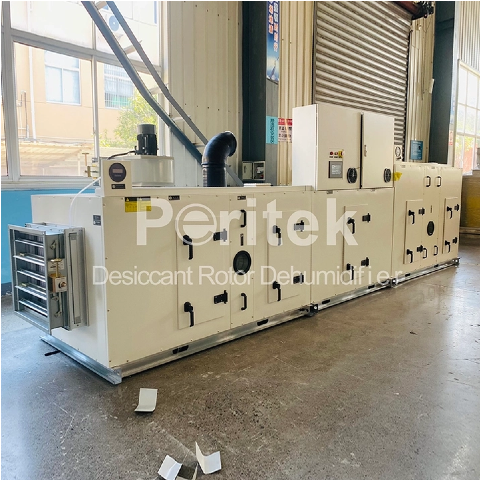
A rotary dehumidifier's successful implementation depends on seamless integration with existing air handling systems and cleanroom environments.
Rotary dehumidifiers are commonly installed within Air Handling Units (AHUs) for centralized humidity control or as standalone local conditioning units serving specific production areas. Ducted configurations distribute dehumidified air through the facility's ventilation network, ensuring uniform humidity control, while non-ducted units condition air directly within a targeted zone. Placement depends on facility layout, production process requirements, and airflow considerations.
Modern pharmaceutical plants often adopt modular cleanroom designs where flexible placement of dehumidification units is essential. The ability of rotary dehumidifiers to be customized in size and capacity allows them to fit diverse plant layouts without extensive remodeling.
Precise control and monitoring are critical. Sensors for RH, temperature, and airflow must be strategically placed to capture accurate environmental data. Advanced control systems adjust rotor speed, regeneration temperature, and airflow to maintain target RH levels. Validation protocols verify that the system consistently meets pharmaceutical industry standards and GMP compliance, ensuring product safety and regulatory adherence.
Sophisticated software interfaces also facilitate remote monitoring and data logging, supporting audit trails and continuous improvement programs in pharmaceutical quality management.
Deploying rotary dehumidifiers offers tangible operational advantages, but requires routine maintenance to sustain optimal performance.
Stable low-humidity environments reduce batch rejects caused by moisture-related defects, improving yield and lowering production costs. Predictable drying times streamline process scheduling and reduce downtime. Consistent humidity control also diminishes variability between production lots, supporting quality assurance and regulatory compliance.
Additionally, the reduction in energy consumption and equipment wear compared to conventional drying methods contributes to lower operational costs and longer equipment lifespan, further benefiting pharmaceutical manufacturers.
Routine maintenance includes inspecting and replacing the desiccant rotor as its moisture-adsorbing capacity diminishes over time. Filters must be regularly cleaned or replaced to prevent contamination and airflow restrictions. Heater elements used in the reactivation process require periodic testing to ensure energy-efficient operation and prevent overheating. Well-planned maintenance schedules maximize equipment lifespan and reliability.
Moreover, preventive maintenance plans help avoid unexpected downtime, ensuring continuous production and adherence to strict manufacturing timelines.
Selecting the right rotary dehumidifier involves evaluating several technical and operational factors to ensure compatibility with pharmaceutical industry needs.
Determine the required dew point or relative humidity target based on specific process demands. Airflow capacity must align with production volume and ventilation rates. Reactivation energy consumption impacts operating costs and should be optimized for efficiency. Additionally, footprint and installation dimensions must fit available plant space without disrupting existing infrastructure.
Pharmaceutical plants should also consider scalability and system adaptability to accommodate future expansions or process changes.
Ensure the supplier provides thorough validation support, including performance data, compliance certificates, and assistance with GMP documentation. Supplier reliability, after-sales service, and technical expertise are equally important for long-term operational success.
Selecting a partner experienced in pharmaceutical environments, such as Hangzhou Peritech Dehumidifying Equipment Co., Ltd., ensures not only cutting-edge technology but also compliance with rigorous industry standards.
A properly selected rotary dehumidifier is indispensable for pharmaceutical industries striving to maintain product integrity and process stability. Hangzhou Peritech Dehumidifying Equipment Co., Ltd. offers advanced rotary dehumidification solutions tailored to meet stringent pharmaceutical humidity control requirements. Partnering with Peritek ensures access to cutting-edge technology, rigorous quality standards, and dedicated support. To explore how our rotary dehumidifier can enhance your pharmaceutical manufacturing environment, contact us today for consultations and pilot testing.


