
English
Views: 0 Author: Site Editor Publish Time: 2025-10-24 Origin: Site


Controlling humidity levels precisely is essential across many industries, especially where conventional dehumidification methods fall short. A rotary dehumidifier, particularly the rotary desiccant dehumidifier, provides reliable and energy-efficient moisture control, ensuring optimal conditions for sensitive processes. Hangzhou Peritech Dehumidifying Equipment Co., Ltd., with over 30 years of experience, specializes in advanced rotary desiccant systems that meet diverse industrial needs worldwide.
At its core, a rotary desiccant dehumidifier is designed to remove moisture from the air using a rotating wheel coated with desiccant material. Unlike traditional refrigeration dehumidifiers that rely on cooling air below its dew point, rotary desiccant systems chemically adsorb water vapor, enabling effective humidity control even at low temperatures or very low relative humidity (RH) levels.
The operation of a rotary dehumidifier depends on two distinct airflow streams — process airflow and reactivation airflow.
Process airflow is the air stream entering the system that requires drying. As it passes through the rotating desiccant rotor, moisture is adsorbed onto the desiccant material, significantly lowering the air’s humidity.
Reactivation airflow serves to regenerate or “reactivate” the desiccant by passing heated air through the rotor on the opposite side. This heated air releases the adsorbed moisture from the desiccant, which then exits as a separate moist air stream.
This adsorption and desorption cycle happens continuously as the rotor spins, allowing for uninterrupted dehumidification. The key advantage is that the system never saturates and maintains stable humidity removal over long operating periods.
Rotary desiccant dehumidifiers are highly versatile in terms of operating conditions. They can efficiently dehumidify air in temperature ranges from near freezing (around 5°C/41°F) up to elevated temperatures (above 50°C/122°F). Moreover, they excel at achieving very low RH levels, often below 10%, which refrigeration dehumidifiers cannot achieve without freezing issues.
This wide performance envelope makes rotary desiccant technology the preferred choice in applications demanding precise moisture control under challenging environmental conditions.
Rotary desiccant dehumidifiers are employed across a broad range of sectors where humidity control is critical for product quality, process efficiency, or preservation.
In food manufacturing, maintaining low humidity is vital to prevent spoilage, microbial growth, and ensure product consistency during drying processes. Rotary desiccant systems help create the ideal drying environment, improving throughput and reducing energy consumption compared to conventional methods.
Pharmaceutical production demands stringent humidity control to protect sensitive raw materials and finished products from moisture-related degradation. Rotary desiccant dehumidifiers provide stable, low-humidity air essential for cleanroom environments and manufacturing processes such as tablet coating or powder drying.
Cold storage environments often face the challenge of condensation, frost buildup, and mold growth due to temperature fluctuations. The desiccant rotor’s ability to remove moisture at low temperatures without condensation issues enhances product preservation and reduces maintenance costs.
Preserving historical artifacts, documents, and artworks requires an environment with controlled low humidity to prevent mold, corrosion, or brittleness. Archives benefit from rotary desiccant dehumidifiers because they can maintain low RH levels at cooler temperatures, conditions in which refrigeration systems struggle.
Archives operate at lower temperatures to slow chemical and biological degradation. Maintaining low RH without condensation or ice formation is crucial. Rotary desiccant dehumidifiers excel here by adsorbing moisture directly rather than condensing it, enabling safe, long-term preservation.
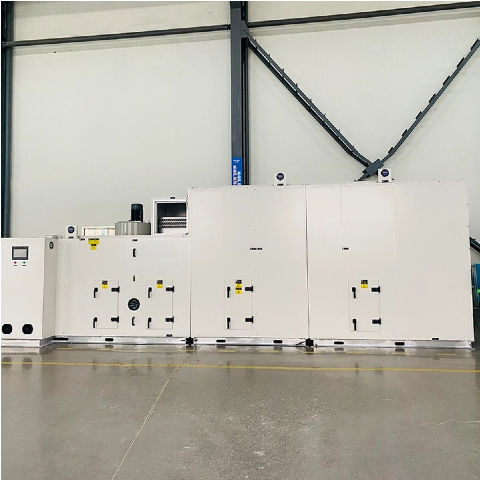
Rotary desiccant dehumidifiers hold distinct advantages compared to refrigeration or chemical drying technologies, especially in demanding industrial environments.
Unlike refrigeration dehumidifiers, which condense water and require drainage systems, rotary desiccant systems adsorb moisture without producing liquid condensate. This eliminates the need for condensate handling equipment, reducing maintenance.
Their ability to maintain consistent, very low RH levels, even at low temperatures, ensures tight humidity control that refrigeration systems cannot match.
Rotary desiccant units are available in various sizes and configurations, allowing them to be tailored precisely to the airflow and drying requirements of any facility. Their modular nature means systems can be expanded or adjusted as production demands evolve, providing flexibility and cost efficiency.
Selecting the right rotary desiccant dehumidifier requires understanding the specific moisture load and process requirements.
Airflow volume (measured in cubic feet per minute or CFM) must correspond to the volume of air requiring dehumidification. Calculating the moisture load—the amount of water vapor in the air to be removed—is critical for accurate sizing.
Accurate measurement or estimation of process conditions (temperature, RH, volume) allows engineers to specify a rotary dehumidifier that efficiently meets drying demands without excess energy use.
The energy required to regenerate the desiccant wheel depends on the moisture load and reactivation air temperature. Selecting the proper heater size and power source ensures effective regeneration without oversizing, balancing performance and operational costs.
Rotary desiccant dehumidifiers can be integrated into existing HVAC setups or operate as standalone units. For retrofits, considerations include space availability, ductwork configuration, and electrical capacity.
Choosing a compact modular unit with flexible controls facilitates smooth integration and minimal disruption to ongoing operations.
Ensuring long-term reliable performance requires regular maintenance and operational attention.
Routine replacement of air filters prevents dust and debris buildup that can reduce rotor efficiency. Periodic inspection of the rotor wheel for damage or contamination ensures optimal moisture adsorption.
Heater elements used for reactivation must be checked regularly for proper function to maintain effective desiccant regeneration.
Environmental conditions often change with seasons, affecting humidity loads. Adjusting system settings seasonally optimizes performance and energy consumption, extending equipment lifespan.
The rotary dehumidifier stands out as an efficient, reliable solution for moisture control across a wide range of industrial sectors. Hangzhou Peritech Dehumidifying Equipment Co., Ltd.’s rotary desiccant dehumidifiers combine advanced technology with decades of expertise to provide precise humidity management, adaptable to various environmental challenges. Whether in pharmaceutical cleanrooms, food processing plants, archives, or cold storage, these systems deliver consistent low RH where conventional methods struggle.
For companies seeking effective moisture control tailored to their unique needs, a rotary dehumidifier is an excellent investment. Contact us today at Hangzhou Peritech to discover how our rotary desiccant dehumidifiers can optimize your operations and protect your products.


