
English
Views: 0 Author: Site Editor Publish Time: 2026-07-14 Origin: Site


Moisture remains the ultimate enemy of lithium-ion cell integrity during production. Even trace amounts of water trigger rapid hydrofluoric acid formation inside the cells. This dangerous chemical reaction increases thermal runaway risks. It also drastically reduces the battery's overall cycle life and performance stability. Achieving ultra-low humidity solves these chemical problems permanently. However, this drying process represents the largest single energy draw in any modern battery manufacturing facility. You must balance strict quality control against massive power consumption.
This guide moves beyond basic definitions to provide actionable engineering insights. We outline exact dew point thresholds for each specific manufacturing stage. You will learn how to evaluate core equipment capabilities effectively. We also provide a clear framework for specifying the right machinery. This approach balances yield protection with operational efficiency. By matching environmental controls to precise process steps, you prevent unnecessary energy waste while securing highly reliable production outcomes.
Manufacturers cannot treat the entire facility as a single, uniform environment. Different production steps demand drastically different environmental controls. Treating every zone identically wastes immense amounts of electrical energy. We must categorize thresholds by specific manufacturing stages to optimize power usage.
Each stage of battery production interacts with ambient moisture differently. You must align your environmental targets with the chemical vulnerability of each specific step.
| Manufacturing Stage | Standard Dew Point Requirement | Primary Moisture Risk |
|---|---|---|
| Electrode Preparation & Coating | -30°C to -40°C | Slurry viscosity changes and uneven foil adhesion. |
| Cell Assembly (Winding/Stacking) | -40°C to -50°C | Moisture trapping inside the wound jelly roll or stacked sheets. |
| Electrolyte Filling & Sealing | -50°C to -60°C (Up to -80°C) | Immediate hydrofluoric acid formation and catastrophic cell degradation. |
The electrode preparation and coating stage handles raw slurries and foils. It generally requires a dew point between -30°C and -40°C. Powders absorb moisture quickly from the surrounding air. This absorption changes the baseline viscosity of the coating slurry. Uneven coating layers lead directly to poor cell performance and localized hot spots.
The cell assembly stage involves rapid winding or stacking of exposed electrodes. This area demands stricter control. Facilities typically maintain -40°C to -50°C in assembly zones. Operators often work closely with the materials in this space. Human bodies emit significant moisture continuously. You must account for this personnel latent load carefully to maintain the threshold.
Electrolyte filling and sealing represents the most critical zone in the plant. Lithium salts react violently and rapidly when exposed to ambient moisture. You universally need a tightly monitored -50°C to -60°C environment here. Sensitive next-generation chemistries demand even drier conditions. Solid-state battery production often requires thresholds up to -80°C to prevent immediate material spoiling.
Variations in cathode materials heavily dictate your approach to battery dry room humidity control. High-nickel NMC (Nickel Manganese Cobalt) cathodes offer superior energy density for electric vehicles. However, they are extremely hygroscopic. They pull moisture from the air aggressively during handling. You must lower the dew point significantly when running high-nickel lines. Conversely, standard LFP (Lithium Iron Phosphate) cells tolerate slightly higher humidity margins without suffering catastrophic degradation.
Many plant engineers simply blanket-specify a -60°C environment for the entire building. This design choice causes an exponential energy penalty. Producing -60°C air requires vastly more electrical and thermal energy than producing -40°C air. You force the HVAC equipment to work at maximum capacity continuously. Micro-environments offer a superior engineering solution. Tiered zoning provides extreme dryness only where absolutely necessary, such as inside customized glove boxes or isolated filling rooms. You protect product yield while saving massive amounts of facility power.
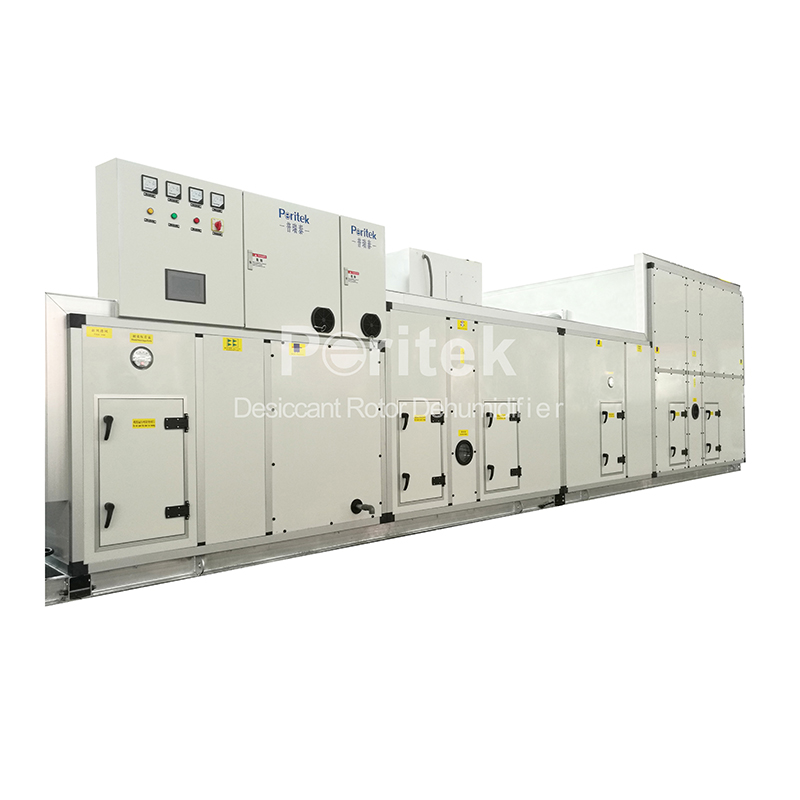
Achieving extreme dryness requires moving beyond conventional air conditioning concepts. We must rely on advanced chemical adsorption rather than simple condensation.
Standard air conditioning systems remove moisture via simple condensation. They pass warm, humid air over cold mechanical coils. The water vapor condenses into liquid drops and drains away. However, this physical process hits a wall at freezing temperatures. Mechanical cooling coils freeze completely solid below 0°C dew points. Ice blocks the airflow entirely. Standard cooling cannot remove moisture further. You need continuous active adsorption to push the environment into deep sub-zero limits.
Reaching sub-zero limits requires specialized, heavy-duty equipment. A desiccant rotor dehumidifier forms the absolute heart of this process. The system uses a massive, slowly turning internal wheel. Manufacturers impregnate this wheel with highly active chemical desiccants. Silica gel and lithium chloride are the most common industrial materials. The porous desiccant structure physically traps airborne water molecules as the air passes through the flutes of the wheel.
Single-rotor systems handle moderate industrial drying requirements. They work well for basic -30°C targets. However, reaching sub--40°C targets requires dual-rotor or twin-wheel configurations. A primary wheel handles the bulk moisture load from the incoming ambient air. A secondary wheel then meticulously polishes the pre-dried air. This staged, sequential approach allows the lithium battery dry room dehumidifier to reach extreme limits efficiently without over-saturating a single desiccant bed.
These industrial systems must manage massive air volumes continuously. They pull return air directly from the facility floor. They mix this return air with highly conditioned make-up air drawn from outside. You need fresh make-up air to maintain positive room pressure. Positive pressure pushes outward aggressively against doors, seals, and pass-throughs. It prevents moist ambient air from infiltrating the controlled space. The equipment must dry this blended air stream instantly. It accomplishes this heavy lifting without compromising the strict dew point limit required by the assembly line.
Decision-makers often focus purely on upfront equipment specifications. You must instead evaluate environmental systems based on their long-term energy consumption and operational footprint. Processing massive volumes of air requires immense, continuous power. Selecting a low dew point dehumidifier demands strict attention to thermal efficiency metrics.
The desiccant wheel absorbs moisture until it becomes chemically saturated. It must release this trapped moisture to continue working. We call this necessary process reactivation. The system blasts a section of the wheel with intense heat to drive the water off. You must evaluate various reactivation heat sources carefully. Steam provides consistent thermal energy if your plant already possesses a boiler infrastructure. Direct-fired gas offers excellent thermal efficiency but requires dedicated fuel routing. Electricity remains the easiest source to install, but it often draws the highest utility demand penalties during peak hours.
Heat recovery systems remain absolutely vital for sustainable operation. Advanced equipment includes dedicated purge sectors on the desiccant wheel itself. These sectors capture residual heat from the intense reactivation process. The system redirects this trapped thermal energy to pre-warm incoming air. This clever routing minimizes the total mechanical cooling load. It drastically reduces overall reactivation energy requirements, allowing the facility to operate with a much leaner power footprint.
The desiccant wheel represents a significant, long-term operational asset. You must fully understand its lifecycle characteristics. Volatile organic compounds (VOCs) and particulates in the air stream degrade the desiccant material over time. You must evaluate performance degradation rates over a standard 5-to-10-year horizon. Some wheels lose their moisture-trapping capacity quickly when exposed to manufacturing fumes. Others maintain high adsorption efficiency for a decade. Factor these rotor replacement intervals into your facility planning. Routine, strict filter changes protect the wheel from irreversible particulate damage.
Building these extreme environments involves complex, multi-disciplinary engineering. Mistakes lead directly to poor product quality and massive wasted energy. You must anticipate and mitigate common physical risks. A battery production dry room operates as a highly delicate, pressurized ecosystem.
Engineers frequently underestimate internal moisture sources during the design phase. Line operators represent a massive latent load. Human bodies exhale and sweat water vapor continuously, even in protective suits. Raw materials also carry hidden moisture into the space on pallets and packaging. Micro-leaks around bay doors, HVAC joints, and cable penetrations allow ambient humidity to creep inside invisibly. These compounding factors force the system into continuous over-exertion. You must calculate these loads generously to provide adequate safety margins.
Specifying a -50°C environment is completely useless without accurate, real-time verification. Standard industrial sensors drift out of calibration rapidly in extreme dryness. You must install high-precision chilled-mirror hygrometers or advanced capacitive sensors designed specifically for trace moisture. Sensor placement matters immensely for quality assurance. You must monitor localized micro-climates actively. Place sensors directly next to open electrolyte filling stations and winding machines. Do not rely exclusively on aggregated readings from the main return air duct, as this masks localized humidity spikes.
Battery production often requires strict ISO-certified particulate cleanliness alongside extreme dryness. Cleanrooms demand incredibly high air change rates to filter microscopic dust. Conversely, extreme dryness requires heavily sealed, tightly controlled air volumes to prevent moisture infiltration. These two opposing requirements create intense mechanical friction. High air velocity can disrupt stable, dry micro-environments. You must balance aggressive HEPA filtration speeds against stable moisture control.
Follow these structured steps to secure your environment:
Buying industrial environmental equipment requires extreme technical diligence. You need verified engineering data before approving any installation. Use this structured approach to vet potential suppliers thoroughly.
Do not accept theoretical performance models blindly. Demand thorough Factory Acceptance Testing (FAT). You should run this test under simulated seasonal extreme conditions. Force the vendor to prove their equipment's performance against high ambient summer humidity profiles. Require transparent psychrometric charts detailing the exact moisture removal process. Ask for verified energy consumption models calculated per CFM of delivered dry air.
Battery chemistry evolves rapidly. Today's standard process might become totally obsolete in three years. Evaluate whether the equipment can adapt seamlessly to future chemistry changes. Can the lithium battery dehumidification system reach deeper dew point thresholds later without a complete facility teardown? Modular systems allow you to add secondary desiccant stages or extra cooling coils in the future. This physical flexibility protects your massive manufacturing infrastructure investment.
Building a successful Request for Proposal (RFP) requires precise, uncompromising parameters. Provide a highly structured framework for competing vendors.
Securing a reliable manufacturing environment remains a highly complex balancing act. It requires matching stringent chemical vulnerability requirements with mechanical energy efficiency. You must achieve ultra-low moisture limits continuously without draining the local utility grid. Success relies on precise engineering rather than brute-force cooling.
We strongly advise decision-makers to prioritize vendor engineering support over basic hardware acquisition. Insist on custom airflow modeling to prevent catastrophic micro-climates on the factory floor. Evaluate the total lifecycle performance and structural durability of the equipment. Long-term energy efficiency and stable operation always outweigh short-term hardware compromises.
Take immediate action to secure your production line. Request a comprehensive engineering consultation from a qualified environmental equipment manufacturer. Ask them to perform a lifecycle energy analysis based specifically on your plant's geographic location. Download a technical sizing guide to refine your internal airflow calculations and protect your cell yields.
A: You must use high-precision sensors like chilled-mirror hygrometers for ultra-low ranges. Advanced capacitive sensors work well for general zones. Calibrate these sensors frequently to prevent measurement drift. Always place sensors directly near critical manufacturing nodes, like filling stations. Do not rely solely on readings from the main return air duct, as localized moisture pockets easily form around personnel and active machinery.
A: No. Standard HVAC systems rely on mechanical cooling coils. These coils freeze solid when temperatures drop below a 0°C dew point. They are physically incapable of reaching the -40°C to -60°C thresholds required for battery production. You must use active desiccant rotors. These specialized chemical wheels physically adsorb moisture from the air stream continuously, bypassing the freezing limits of standard refrigeration.
A: There is no single ideal air change rate. The exact requirement varies significantly based on your specific facility architecture. Internal moisture loads dictate the baseline airflow needed for humidity control. Furthermore, if you must meet strict ISO particulate cleanliness standards, you will need much higher air change rates. You must balance heavy HEPA filtration requirements against preserving stable dry air volumes.


