
English
Views: 0 Author: Site Editor Publish Time: 2025-11-10 Origin: Site


Maintaining precise humidity control is a critical factor in ensuring cleanroom performance, and rotary dehumidifiers stand out as reliable solutions to meet these stringent requirements. Among them, the desiccant rotor dehumidifier offers unique advantages tailored for the demanding environments of pharmaceutical, biotech, and electronics cleanrooms. Hangzhou Peritech Dehumidifying Equipment Co., Ltd., with over three decades of expertise in air dehumidification, provides advanced desiccant rotor technology designed to keep cleanrooms stable and contamination-free.
Cleanrooms serve a diverse range of applications, each requiring specific relative humidity (RH) targets to maintain product quality and operational efficiency. In the pharmaceutical industry, RH is typically controlled between 30% and 50%, optimizing conditions for drug manufacturing and preventing microbial growth. Biotech cleanrooms demand a similar range but with tighter control, often maintaining RH levels near 40% to avoid enzyme degradation or protein denaturation. Meanwhile, electronics manufacturing cleanrooms maintain RH levels often below 45%, sometimes as low as 20%-30%, to prevent corrosion and electrostatic discharge risks.
Failure to maintain target RH can cause significant issues affecting both product integrity and process reliability. Variations in humidity can introduce test variability in pharmaceutical assays, leading to inconsistent batch quality. High humidity increases the risk of particulate adhesion and microbial contamination, compromising the sterile environment. In electronics, elevated moisture levels may cause corrosion on sensitive components, while excessively low humidity can generate static electricity, damaging delicate circuitry. Thus, achieving and sustaining precise humidity levels is non-negotiable in cleanroom operations.
A desiccant rotor consists of a rotating wheel impregnated with hygroscopic material—commonly silica gel or molecular sieves—that adsorb moisture from the process air stream. The rotor continuously cycles between two sectors: the process air sector, where moisture is absorbed, and the reactivation sector, where moisture is driven off by heated purge air. This process enables the rotor to produce consistently dry air at low dew points, often reaching below -40°C, a critical feature for cleanrooms requiring stringent humidity control.
Desiccant rotor technology inherently minimizes particulate generation, a key advantage in contamination-sensitive cleanrooms. The sealed rotor design and high-quality casing materials prevent leakage and airborne dust intrusion. Unlike refrigeration-based dehumidifiers, desiccant rotors do not rely on condensation processes that can foster microbial growth or water droplets. As a result, the air supplied is not only dry but also cleaner, aligning perfectly with the strict particulate standards of pharmaceutical and electronics cleanrooms. Companies like Terra Universal have demonstrated that desiccant rotors maintain superior air purity alongside moisture control, making them the dehumidification method of choice in critical environments.
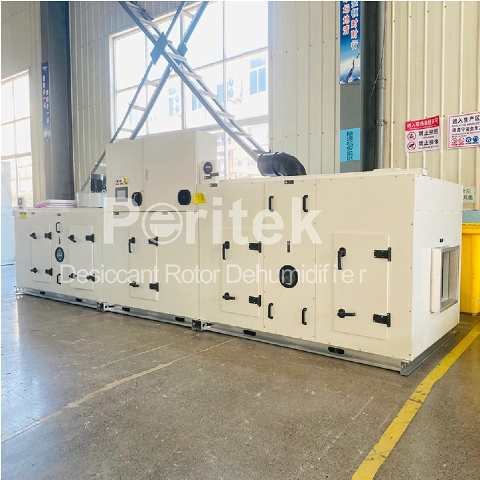
Cleanroom applications demand robust and precise equipment design. The choice between vertical and horizontal rotor mounting affects maintenance accessibility and airflow patterns. Vertical mounting often facilitates easier rotor replacement and better space utilization, while horizontal mounting can simplify ducting arrangements. The rotor casing materials must be corrosion-resistant and easy to clean—typically stainless steel or powder-coated aluminum—to comply with cleanroom hygiene standards. Effective sealing at rotor interfaces is crucial to prevent air bypass and maintain consistent dehumidification performance.
Proper ducting design ensures that the supply air remains uncontaminated and that reactivation purge air does not compromise cleanroom conditions. Purge air should be routed carefully through dedicated exhaust paths, ideally vented outside the cleanroom envelope, to avoid cross-contamination. Positioning the exhaust outlet away from air intakes and pedestrian traffic zones minimizes re-entrainment of contaminants. These considerations collectively support the stable operation of the desiccant rotor dehumidifier and uphold cleanroom integrity.
Advanced cleanroom facilities often integrate desiccant rotor dehumidifiers with Building Management Systems (BMS) to enable real-time monitoring and control. Proportional-Integral-Derivative (PID) controllers regulate humidity setpoints precisely by adjusting rotor speed and reactivation temperature. This dynamic control optimizes energy use while maintaining RH within desired limits. Data logging capabilities ensure continuous documentation of humidity conditions, supporting audits and regulatory compliance, critical in industries such as pharmaceuticals.
Before commissioning, desiccant rotor systems undergo rigorous qualification tests, including Installation Qualification (IQ), Operational Qualification (OQ), and Performance Qualification (PQ). These procedures verify equipment installation correctness, operational parameters, and sustained humidity control performance under varying conditions. Particle counts and microbiological tests confirm the system’s compatibility with cleanroom standards. Thorough validation guarantees that the desiccant rotor meets both internal quality requirements and external regulatory mandates.
Desiccant rotor reactivation requires heat, which can be supplied electrically or by utilizing waste heat from other processes, improving overall plant efficiency. Electric heaters offer precise temperature control and easy integration but may result in higher operational costs. Utilizing waste heat reduces energy consumption and carbon footprint, aligning with sustainable facility management goals. Additionally, energy recovery loops can capture and reuse heat from the purge air exhaust, further enhancing system efficiency.
While the initial investment for desiccant rotor dehumidifiers may be higher than conventional refrigeration systems, the lifecycle costs often prove advantageous, especially in low-RH scenarios typical of cleanrooms. Refrigeration systems struggle to maintain extremely low dew points without excessive energy use or risk of microbial growth in condensate. In contrast, desiccant rotors provide stable low humidity with less maintenance and longer service life. Companies like Terra Universal have documented the long-term cost benefits of desiccant rotor solutions, reinforcing their position as a preferred option for cleanroom humidity control.
For environments where maintaining stringent relative humidity is critical, rotary dehumidifiers—particularly desiccant rotor dehumidifiers—offer unmatched reliability, air quality, and energy efficiency. Hangzhou Peritech Dehumidifying Equipment Co., Ltd. brings decades of expertise in delivering customized desiccant rotor solutions tailored to the unique needs of pharmaceutical, biotech, and electronics cleanrooms. To optimize cleanroom humidity control, we recommend proper pilot sizing and thorough supplier audits to ensure seamless integration and long-term performance. For more information about our rotary dehumidifier product line or to discuss your cleanroom humidity requirements, please contact us.


